St Patrick's Catholic Primary School

Music

Music is a universal language that embodies one of the highest forms of creativity. A high quality music education should engage and inspire pupils to develop a love of music and their talent as musicians, and so increase their self-confidence, creativity and sense of achievement. As pupils progress, they should develop a critical engagement with music, allowing them to compose, and to listen with discrimination to the best in the musical canon.
National Curriculum 2014
Music Curriculum Intent
At St Patrick’s Catholic Primary School, our Music curriculum is ambitious, inclusive and carefully sequenced to inspire a lifelong love and appreciation of music. Through listening, performing, composing and evaluating, pupils develop the knowledge, skills and confidence to express themselves creatively and participate fully in musical experiences.
Our curriculum aims to ensure that all pupils:
- Develop a secure understanding of the key elements of music, including pulse, rhythm, pitch, tempo, dynamics, timbre and structure.
- Appreciate and respond to a wide range of musical styles, traditions and cultures from different historical periods and communities.
- Develop confidence and enjoyment in singing, playing instruments, improvising, composing and performing.
- Build resilience, creativity and teamwork through collaborative musical experiences.
- Use appropriate musical vocabulary to describe, analyse and evaluate music.
- Understand how music can communicate ideas, emotions, faith and culture.
- Develop an appreciation of music as an important part of personal wellbeing and community life.
- Experience the joy of music-making through high-quality classroom teaching, performances and enrichment opportunities.
Through the Charanga Musical School Scheme, learning is carefully sequenced from EYFS to Year 6, allowing pupils to revisit and build upon prior knowledge through retrieval practice and regular performance opportunities. High-quality assessment enables teachers to identify misconceptions, adapt teaching and ensure all pupils can access the same ambitious curriculum regardless of their starting point.
As a Catholic school, music plays a significant role in worship, prayer and celebration. Through collective worship, liturgical celebrations, school performances and community events, pupils develop confidence, self-expression and a sense of belonging while recognising the power of music to inspire, unite and enrich lives.
By the time pupils leave St Patrick’s, they will be confident musicians who can perform, compose, listen critically and appreciate a broad range of musical experiences. They will possess the knowledge, skills and enthusiasm needed to continue their musical education and participate positively in the cultural life of their communities.
Curriculum Implementation
Our teaching and implementation of Music is based on the National Curriculum and is supported through the Charanga Musical School Scheme, which provides a carefully sequenced programme of learning from EYFS to Year 6.
The curriculum is designed to ensure progression in:
- Listening and Appraising.
- Singing.
- Playing Instruments.
- Improvising.
- Composing.
- Performing.
Detailed long-term and medium-term planning ensures pupils revisit and build upon previously taught musical knowledge and skills. Key musical vocabulary is explicitly taught and revisited throughout units, enabling pupils to confidently discuss and evaluate music using accurate terminology.
Strong assessment practices are embedded throughout Music lessons. Teachers use ongoing formative assessment to identify misconceptions, adapt teaching and ensure all pupils are able to access and succeed within the curriculum. Retrieval opportunities are built into learning sequences to support pupils in knowing more and remembering more over time.
Adaptive teaching ensures all pupils, including those with SEND, disadvantaged pupils and pupils with English as an Additional Language, can participate fully and successfully in musical learning and performance opportunities.
Music is enriched through a variety of practical experiences and performance opportunities. These include:
- Whole-school performances.
- Nativity productions.
- Easter performances.
- Leavers' performances.
- Telford Sings.
- Young Voices.
- Community performances at Southwater.
- Rocksteady bands.
- Instrumental tuition.
These opportunities enable pupils to develop confidence, teamwork, resilience and performance skills whilst experiencing the joy of making music together.
EYFS
Within Expressive Arts and Design, children:
- Listen and respond to a variety of music.
- Explore rhythm, movement and dance.
- Sing songs, rhymes and nursery rhymes.
- Experiment with instruments and sound-making.
- Participate in performances and celebrations.
- Develop their ability to match pitch and melody.
Children regularly engage with music through stories, songs, movement activities, worship and performances. Experiences such as BBC Let's Move further support children's understanding and appreciation of music.
Key Stage 1 and Key Stage 2
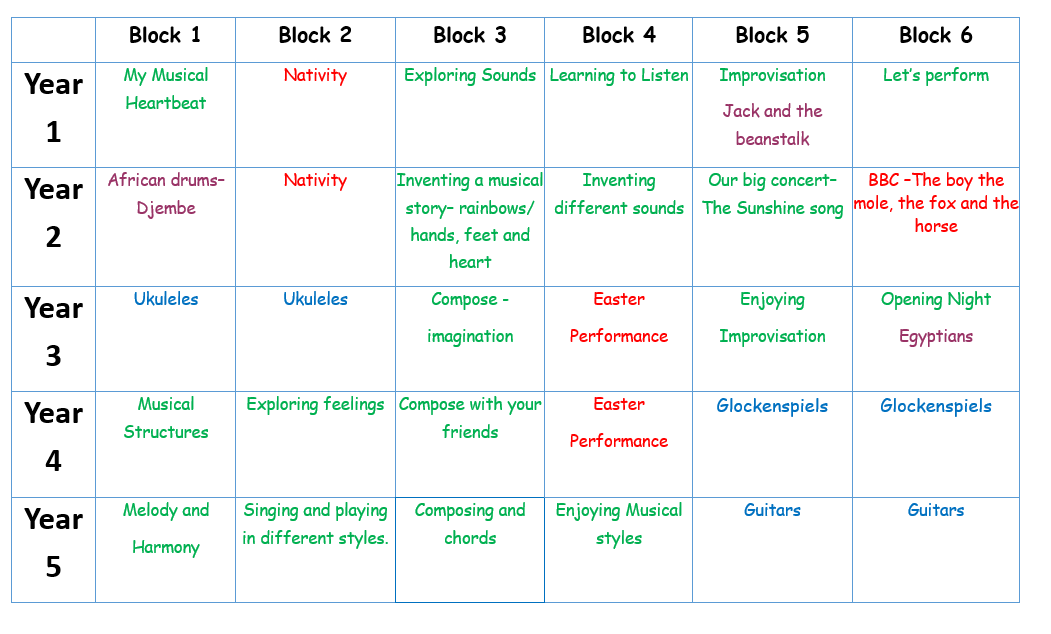
Through these units, pupils progressively develop musical knowledge, technical skills and understanding while experiencing a broad range of musical genres and styles.
Instrumental and Performance Opportunities
Additional opportunities include:
- Rocksteady Bands.
- Choir participation.
- Young Voices.
- Community performances.
- School productions and performances.
These experiences help pupils develop musicianship, confidence and a strong sense of belonging within the school community.
Curriculum Impact
The impact of our Music curriculum is demonstrated through pupils who enjoy music, participate enthusiastically and develop increasing confidence as performers, composers and listeners.
Through carefully sequenced learning, retrieval practice and strong assessment, pupils develop secure musical knowledge and skills that build progressively throughout their time at St Patrick's.
Pupils can:
- Sing confidently and accurately.
- Perform individually and as part of an ensemble.
- Compose and improvise using a range of musical elements.
- Listen to and evaluate music thoughtfully.
- Use musical vocabulary accurately.
- Recognise and understand different genres, styles and traditions.
- Demonstrate an appreciation of music from diverse cultures and historical periods.
- Apply their understanding of musical elements within their own performances and compositions.
Teachers assess achievement through:
- Performance outcomes.
- Observation of practical activities.
- Musical discussions and pupil voice.
- Vocabulary assessments.
- Knowledge organisers.
- Self and peer assessment.
- Ongoing formative assessment.
- End-of-unit performances.
The wider impact of Music is measured through:
- Pupil interviews.
- Learning walks.
- Performance opportunities.
- Staff professional dialogue.
- Annual reports to parents.
- Subject leader monitoring and evaluation.
As a result, pupils leave St Patrick’s as confident musicians who appreciate the power and enjoyment of music. They possess the knowledge, skills and enthusiasm needed to continue their musical education and participate fully in the cultural life of their communities.