St Patrick's Catholic Primary School

Science
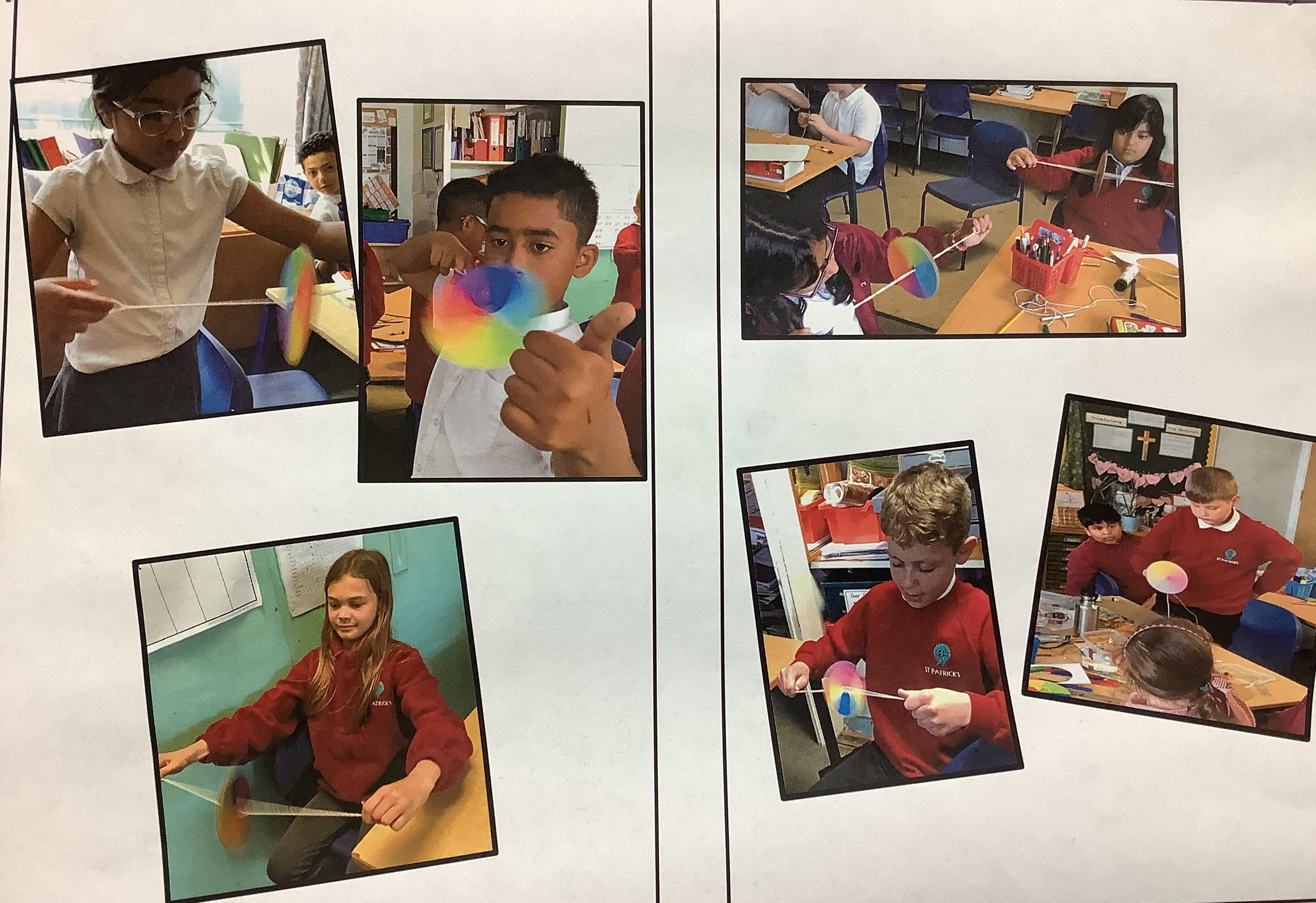
Science Investigations Y5
A high-quality science education provides the foundations for understanding the world through the specific disciplines of biology, chemistry and physics. Science has changed our lives and is vital to the world’s future prosperity, and all pupils should be taught essential aspects of the knowledge, methods, processes and uses of science. Through building up a body of key foundational knowledge and concepts, pupils should be encouraged to recognise the power of rational explanation and develop a sense of excitement and curiosity about natural phenomena. They should be encouraged to understand how science can be used to explain what is occurring, predict how things will behave, and analyse causes.
National Curriculum 2014
Curriculum Intent
At St Patrick’s Catholic Primary School, our Science curriculum is ambitious, engaging and carefully sequenced to develop pupils’ curiosity, knowledge and understanding of the world around them. Science plays a vital role in helping pupils understand both the natural and physical world while encouraging them to question, investigate and think critically.
Our Science curriculum aims to ensure that all pupils:
-
Develop secure scientific knowledge and conceptual understanding through the disciplines of biology, chemistry and physics.
-
Understand the nature, processes and methods of science through a range of scientific enquiries.
-
Develop curiosity, resilience and confidence when investigating scientific questions.
-
Acquire and apply scientific vocabulary accurately and confidently.
-
Understand the uses, significance and implications of science in the modern world.
-
Appreciate the contribution of scientists and scientific discovery throughout history.
-
Recognise the importance of science in shaping the future and addressing global challenges.
-
Develop the skills required to work scientifically and think critically.
Through high expectations, practical enquiry and meaningful learning experiences, we aim to inspire children to become confident scientists who can make sense of the world around them and apply their learning to real-life situations.

Curriculum Implementation
At St Patrick’s, Science is taught for a minimum of two hours each week. Our teaching and implementation of Science is based on the National Curriculum and is supported by detailed long-term and medium-term planning to ensure full curriculum coverage and progression of knowledge and skills from EYFS to Year 6.
Learning is carefully sequenced so that pupils build upon prior knowledge, revisit key scientific concepts and develop increasingly sophisticated understanding over time. Retrieval practice is embedded throughout the curriculum to support pupils in knowing more and remembering more. Prior learning is regularly revisited through questioning, quizzes, discussion, vocabulary review and practical investigations.
The curriculum develops knowledge and understanding across the three scientific disciplines:
-
Biology
-
Chemistry
-
Physics
Alongside substantive knowledge, pupils develop a secure understanding of the five types of scientific enquiry:
-
Observing over time
-
Pattern seeking
-
Identifying, classifying and grouping
-
Comparative and fair testing
-
Research using secondary sources
Vocabulary is explicitly taught and revisited throughout each unit to ensure children can confidently use scientific language when explaining their understanding. Careful consideration is given to vocabulary progression so that knowledge can be transferred across subjects and applied effectively in different contexts.
Strong assessment practices are embedded throughout teaching. Teachers use questioning, retrieval activities, practical investigations, discussion, written outcomes and end-of-unit assessments to identify misconceptions and adapt teaching accordingly. Adaptive teaching ensures all pupils, including those with SEND, disadvantaged pupils and those with English as an Additional Language, can successfully access the same ambitious curriculum and achieve highly.
Enrichment
Science learning is enhanced through a range of enrichment opportunities including:
-
British Science Week.
-
Outdoor learning activities.
-
Forest School.
-
Environmental projects.
-
Whole-school assemblies linked to current scientific issues.
-
Exploration of diverse scientists linked to curriculum topics.
-
STEM links throughout the curriculum.
National and global issues such as climate change, sustainability, biodiversity, recycling and the impact of plastics are explored through assemblies, classroom discussions and curriculum learning. Pupils are encouraged to understand their role as responsible citizens and stewards of God's creation.
EYFS
Within Understanding the World, children begin developing scientific understanding by exploring, questioning and observing the world around them.
Children:
-
Explore the natural world through observation and discussion.
-
Observe seasonal changes.
-
Plant seeds and care for growing plants.
-
Investigate animals and habitats.
-
Explore materials and their properties.
-
Begin to understand changes in matter and the environment.
-
Develop curiosity through outdoor learning and practical exploration.
Science in EYFS provides the foundation for future scientific learning by encouraging children to ask questions, make observations and discuss what they notice.
Key Stage 1
Science teaching focuses on developing pupils' understanding of the world around them through practical exploration and simple scientific enquiry.
Year 1
-
Plants
-
Animals Including Humans
-
Seasonal Changes
-
Everyday Materials
Year 2
-
Living Things and Their Habitats
-
Plants
-
Animals Including Humans
-
Uses of Everyday Materials
Key Stage 2
Pupils build upon prior learning and develop increasingly sophisticated scientific understanding through enquiry-based learning.
Year 3
-
Plants
-
Animals Including Humans
-
Rocks
-
Light
-
Forces and Magnets
Year 4
-
Living Things and Their Habitats
-
Animals Including Humans
-
States of Matter
-
Sound
-
Electricity
Year 5
-
Living Things and Their Habitats
-
Animals Including Humans
-
Properties and Changes of Materials
-
Earth and Space
-
Forces
Year 6
-
Living Things and Their Habitats
-
Animals Including Humans
-
Evolution and Inheritance
-
Light
-
Electricity
Throughout all year groups, pupils are encouraged to make predictions, plan investigations, collect evidence, analyse results and draw conclusions using appropriate scientific language.
Curriculum Impact
The impact of our Science curriculum is demonstrated through pupils who are curious, knowledgeable and confident scientists. They develop a secure understanding of scientific concepts and can apply their learning to explain the world around them.
Through carefully sequenced learning, retrieval practice, practical investigations and strong assessment systems, pupils gain a deep understanding of scientific knowledge and develop the skills required to work scientifically.
Pupils can:
-
Ask relevant scientific questions.
-
Plan and carry out investigations.
-
Make observations and record findings accurately.
-
Use scientific vocabulary confidently.
-
Explain scientific concepts and processes.
-
Analyse evidence and draw conclusions.
-
Understand the role science plays in everyday life.
-
Appreciate the contribution of scientists from a range of backgrounds and cultures.
-
Apply scientific knowledge to real-world issues and challenges.
Throughout each unit, teachers assess learning through:
-
Retrieval questions.
-
Vocabulary assessments.
-
Practical investigations.
-
Knowledge organisers.
-
Enquiry skill tasks at the end of each lesson
-
Quick quizzes.
-
Self and peer assessment.
-
End-of-unit assessments.
The wider impact of Science is measured through:
-
Book looks and work scrutiny.
-
Pupil voice interviews.
-
Learning walks.
-
Peer Lesson observations/coaching sessions.
-
Professional dialogue.
-
Staff meetings.
-
Annual reports to parents.
-
Subject leader monitoring and evaluation.
Statutory teacher assessment is completed at the end of EYFS and Key Stage 2, with outcomes reported to parents. Assessment information is analysed by the Science Lead and used to inform future curriculum development.
As a result, pupils leave St Patrick’s with a secure foundation of scientific knowledge and enquiry skills, a curiosity about the world around them and an appreciation of how science shapes our lives today and in the future. They are well-prepared for the next stage of their education and equipped to become informed, responsible and inquisitive citizens.